The goal
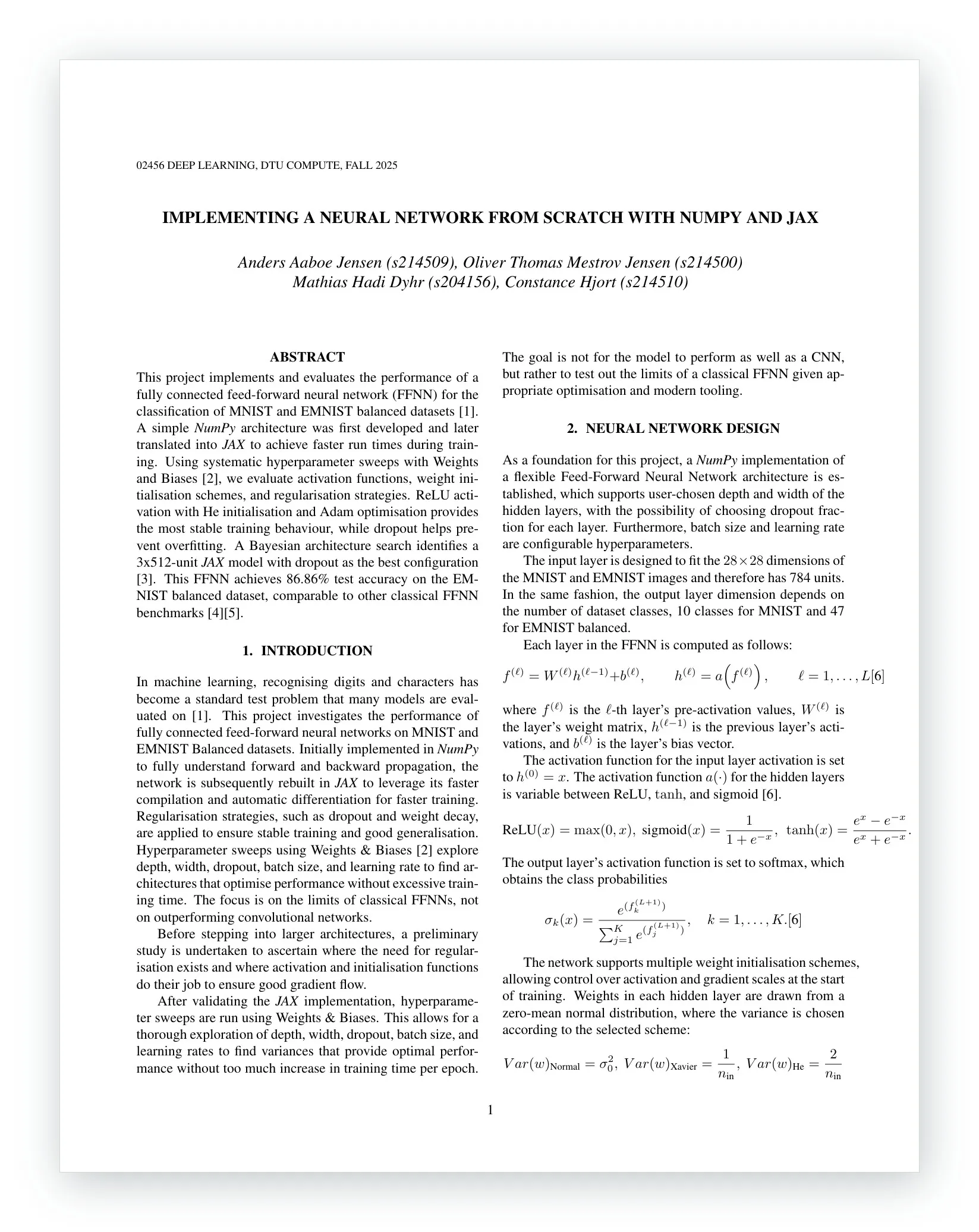
The aim of this DTU Deep Learning group project (course 02456, autumn 2025) was to develop a fully connected neural network without frameworks such as PyTorch or TensorFlow, with the forward pass, gradients and optimisers implemented by hand, and to push its performance as far as possible on handwritten digits (MNIST) and the harder 47-class EMNIST Balanced dataset of digits and letters.
My involvement
Contributed to the development of the original NumPy network, carried out the port to JAX, built the Weights & Biases sweep setup that drove the hyperparameter search, and carried out the search and optimisation of the final network.
From NumPy to JAX
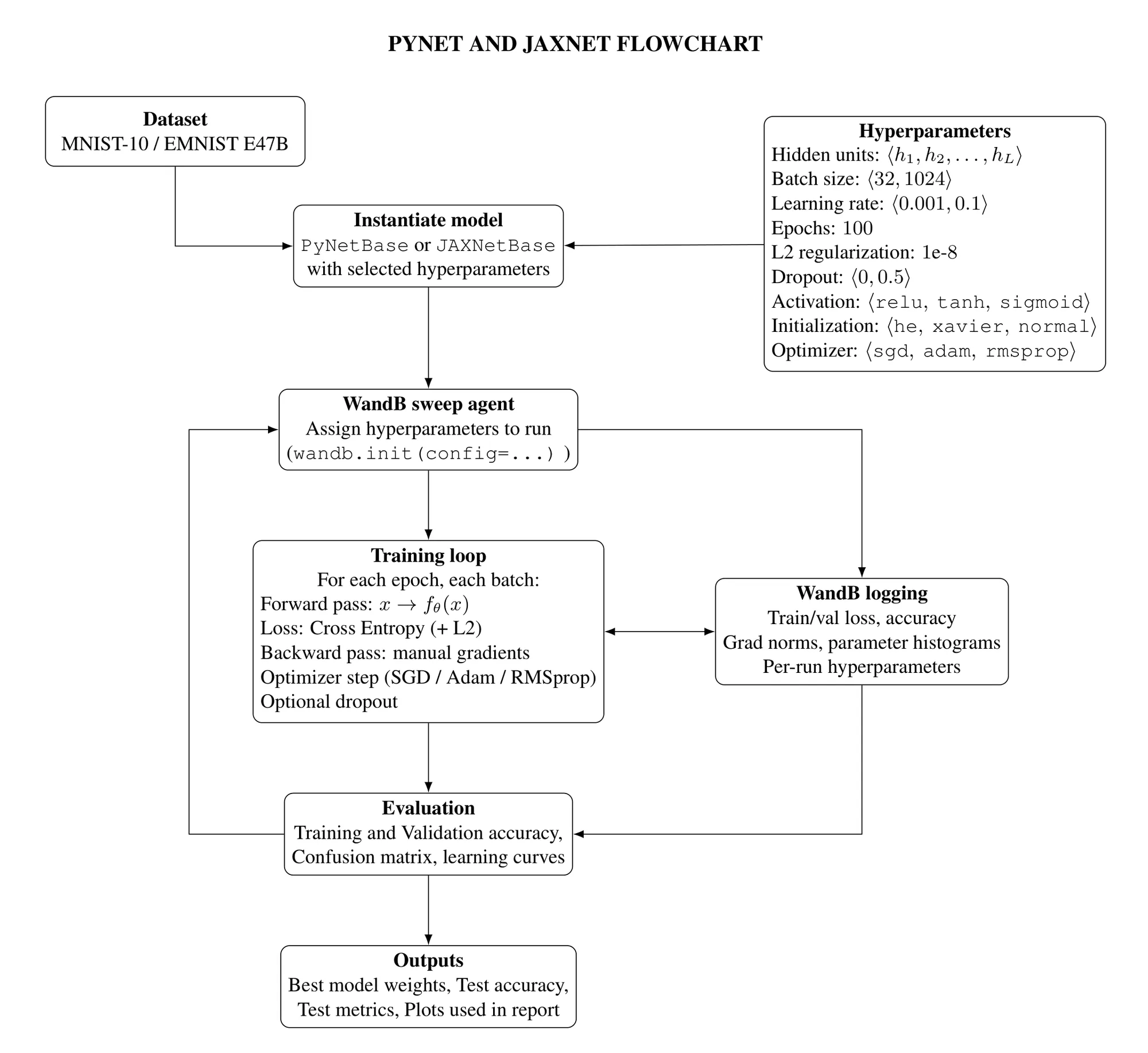
The NumPy network supports configurable depth and width, three activation functions, three weight initialisations, SGD and Adam, weight decay and dropout. It was too slow for systematic sweeps, so it was rewritten in JAX, which keeps a NumPy-like interface but compiles the computation just-in-time and runs it on a GPU. The same sweep, run with both versions:
| Activation | Initialisation | NumPy · runtime | NumPy · val. acc. | JAX · runtime | JAX · val. acc. |
|---|---|---|---|---|---|
| ReLU | Normal | 19 m 6 s | 97.40% | 5 m 39 s | 93.82% |
| ReLU | Xavier | 18 m 53 s | 97.62% | 5 m 32 s | 95.75% |
| ReLU | He | 18 m 48 s | 97.55% | 5 m 29 s | 95.90% |
| Sigmoid | Normal | 21 m 2 s | 94.10% | 5 m 40 s | 87.08% |
| Sigmoid | Xavier | 21 m 7 s | 94.80% | 5 m 39 s | 90.98% |
| Sigmoid | He | 20 m 57 s | 94.83% | 5 m 49 s | 90.63% |
| Tanh | Normal | 23 m 22 s | 94.75% | 5 m 33 s | 94.63% |
| Tanh | Xavier | 23 m 6 s | 95.20% | 5 m 30 s | 94.40% |
| Tanh | He | 23 m 5 s | 95.33% | 5 m 51 s | 94.38% |
MNIST, 2 × 128 hidden units, 100 epochs. NumPy on Google Colab Intel Xeon CPUs (batch 32); JAX on an NVIDIA T4 GPU (batch 512).
Each run became 3.4–4.2 times faster. The slightly lower JAX accuracies, most visible for sigmoid, come mainly from the larger GPU batches, which give 16 times fewer parameter updates per epoch.
| Processor | Architecture | Compute (FP32) | Memory | Used for |
|---|---|---|---|---|
| Intel Xeon (CPU) | Skylake / Cascade Lake | 60–120 GFLOPS | 12–13 GB RAM | NumPy sweeps |
| NVIDIA T4 (GPU) | Turing (TU104) | 8.1 TFLOPS | 16 GB GDDR6 | JAX grid and first Bayesian sweeps |
| NVIDIA A100 (GPU) | Ampere (GA100) | 19.5 TFLOPS | 40 GB HBM2e | Final Bayesian sweep |
Google Colab hardware used for training. Specifications from NVIDIA and Google Cloud documentation.
Finding the best network
Every design choice was tested in sweeps rather than assumed:
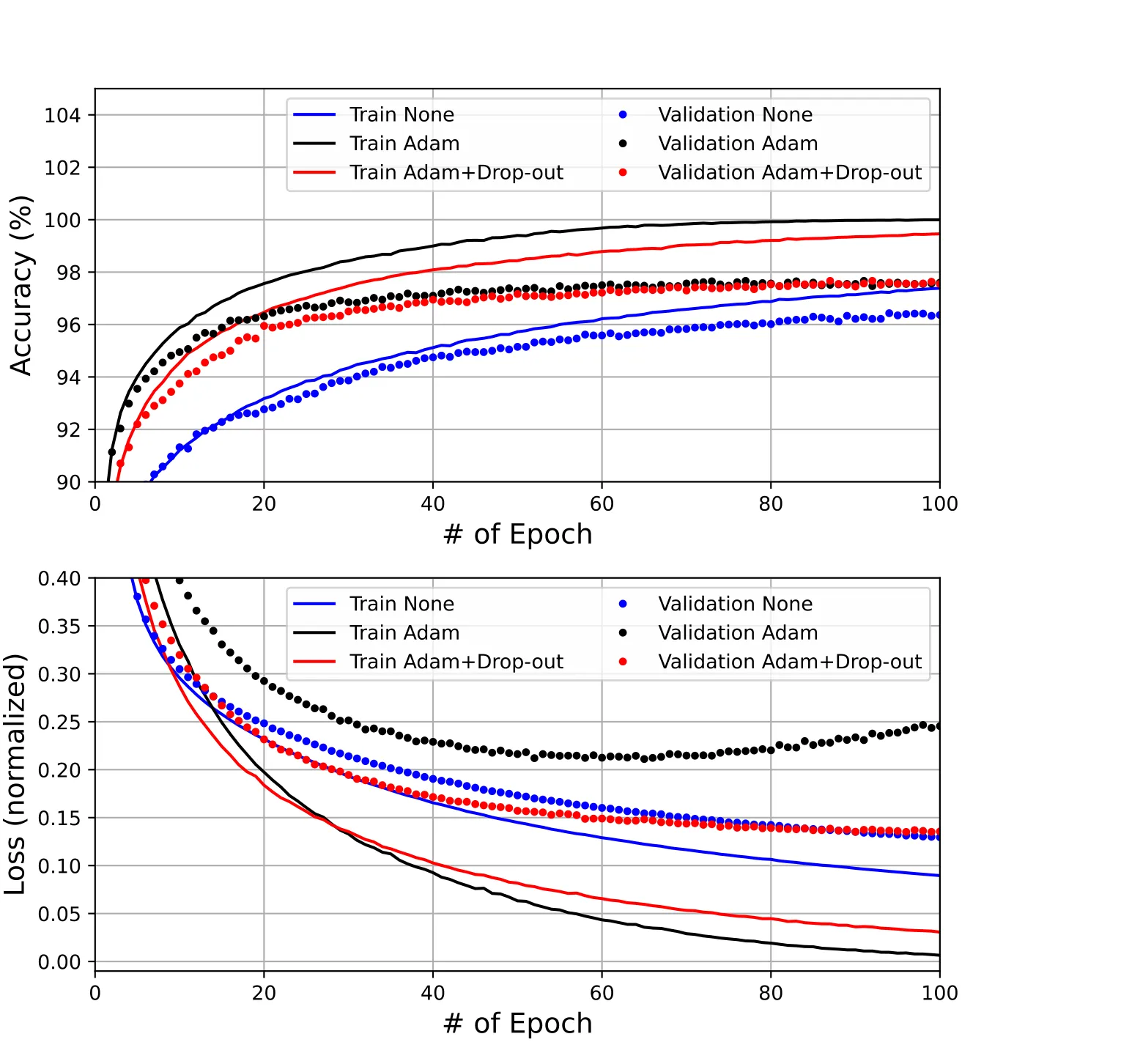
- Regularisation: Adam beat plain SGD but overfitted; 30% dropout removed the overfitting.
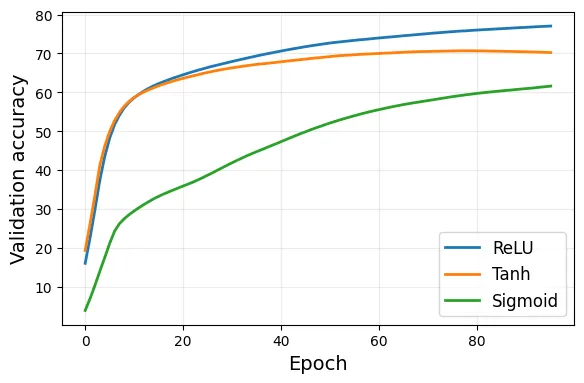
- Activation and initialisation: ReLU clearly outperformed tanh and sigmoid on EMNIST (up to 77% against 70% and 62% for a small network), whose gradients saturate. He and Xavier initialisation performed almost identically.
- Architecture: a Bayesian sweep of 36 runs on an NVIDIA A100 found the best results with about 1000–1500 hidden units in total and 30–40% dropout.
Result
The final network has three hidden layers of 512 ReLU units with 36% dropout, trained with Adam. It reached 86.86% test accuracy on EMNIST Balanced (87.16% validation) in a training time of 10.5 minutes.
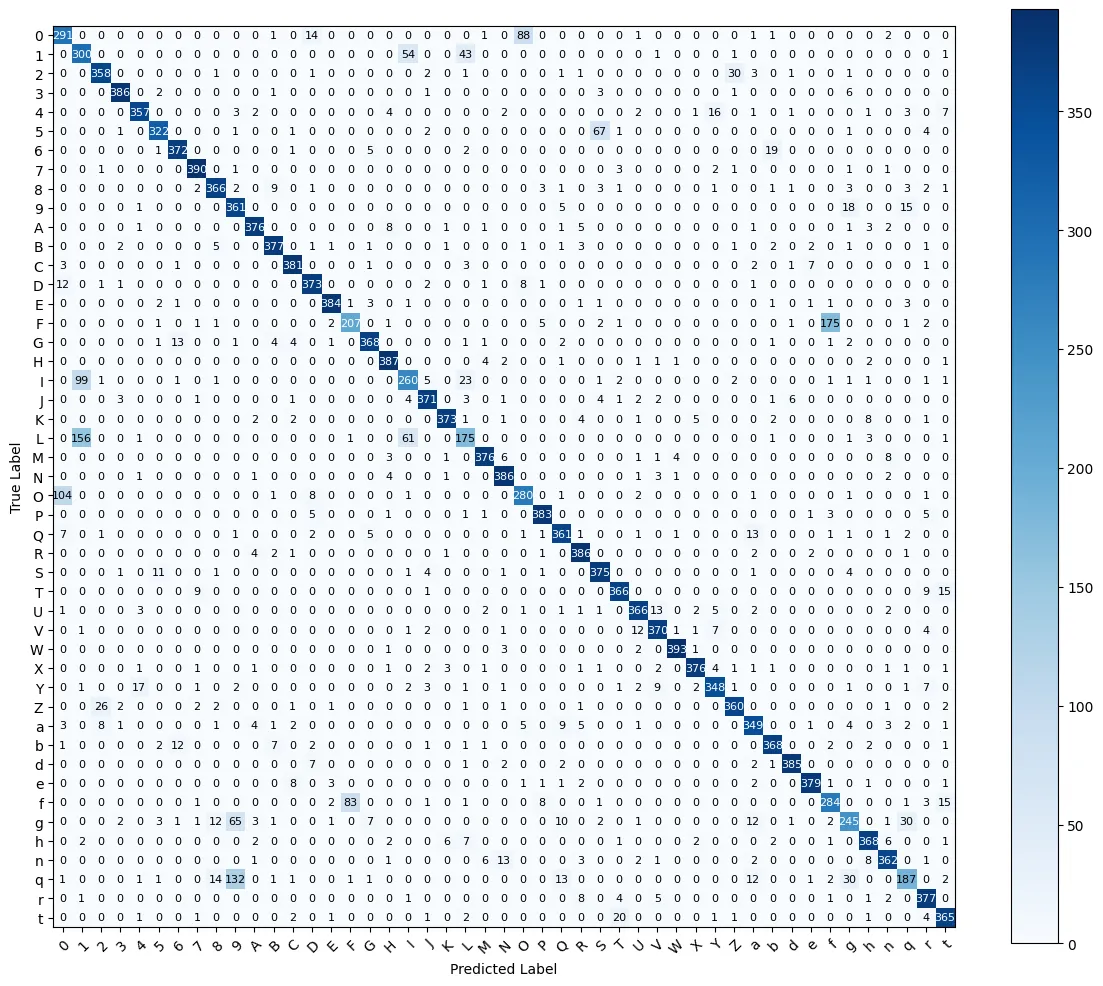
Most remaining errors are characters that are genuinely ambiguous as isolated 28 × 28 images: F is read as f in 44% of test cases, L as 1 in 39% and q as 9 in 33%. A convolutional network, which keeps the image’s spatial structure, would be expected to do better; for a fully connected network, the result is close to the best achievable configuration.